CR-39 is widely used for personal neutron dosimetry. CR-39 is a solid state nuclear track detector (SSNTD).
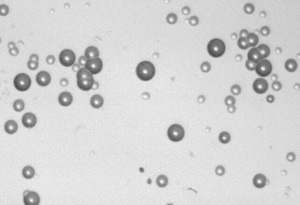
Neutrons tracks CR-39 detector view
The principle of measurement is based on counting of the number tracks etched into the surface of a CR-39 detector after irradiation. These tracks are caused by, either recoil protons produced by the interaction of neutrons with the hydrogen atoms contained in a polyethylene radiator, or alternatively alpha particles produced from the 10B(n, α)7Li reaction in boron loaded radiator.
CR-39 is a polycarbonate plastic comprising: poly-allyl diglycol carbonate (PADC).
Following irradiation, the material is etched in a bath of sodium hydroxide, for approximately 15 hours at 70°C, to enlarge the proton recoil or alpha tracks. The dose is then evaluated by counting the number of tracks.
LANDAUER uses CR-39 produced to our own specifications for our Neutrak® dosimeters.
It covers a broad range of energy: thermal, intermediate and fast neutrons. For the thermal neutrons, a plate of Teflon® charged to boron is added to the dosimeter.
CR-39 is insensitive to x-rays, beta and gamma.